Seems like we learn something new with each new litter.
Miss Pinky Pie went through her pregnancy just fine. She created her nest, her water broke, labor began... but she had NO piglets!
Not even days later.
Not even dead ones.
There was a slight brownish discharge at one point, but that was all. She acted like she was all done with the whole thing, and a week later she came back into heat.
Weirdest thing we'd ever been through. What the heck had happened??
At first it seemed like it might have been caused by Porcine Parvo Virus, but thank goodness it wasn't that! The symptoms didn't quite fit for this common disease. Most piggeries worldwide, large and small, have exposure to Porcine Parvo - think of it like chicken pox (before we all got so freaked out by this common childhood virus) : you get it, you're done and most likely have lifetime immunity. If she had contracted this disease for the first time right after she was bred, either impregnation wouldn't have happened, or there would have been dead piglets at various stages of development. So, not Parvo - what then?
One telling clue was that her milk never did come in, so something hormonal must have been off. Once we started looking into various causes of false pregnancy in pigs, it became clear that the length of her cycle being a week longer than normal was another clue.
That's when things started lining up that it was "F2 Toxin Fungal Poisoning" that caused her to lose the litter in vitro. This F2 toxin is actually Zearalenone which is produced by Fusarium Graminearum, a fungus which is commonly found on grains worldwide: wheat, barley, rice, corn, etc, as well as soybeans. Again, this fungus is one of those things that's just out there, worldwide, all the time.
Normally, the presence of Fusarium isn't going to be too much of a problem. It's unavoidable, anyway. But when we ferment our grains overnight (to break down the phytic acid and thus make more of the nutrition available), it allows the fungus to proliferate which of course increases the amount of Zearalenone toxin.
Zearalenone toxin acts as a megadose of estrogen. (In fact, it is used in the treatment of breast cancer and hormone replacement therapies in humans.) Which explains Miss Pinky Pie's symptoms: longer cycles, false pregnancy to term but with no piglets and no milk production. It's interesting to note that, since we've been feeding this same mix to Mr Red, our young uncut male, it explains his lack of libido, so much so that he doesn't even notice when the sow in the next pen is in heat!
Using Korean Natural Farming inputs (IMO4, LAB, and OHN) during fermentation seems to have some kind of counter-balancing effect, either by introducing enough good bacteria that it overpowers the harmful Fusarium... or perhaps the good stuff actually breaks down the Zearalenone. Without expensive laboratory testing, we cannot know for sure just what is happening, but it sure seems to do the trick. We will definitely be adding these inputs every single time in future.
We had planned on keeping a couple of the gilts from this litter to continue our breeding program and the bloodlines we'd been working on since beginning our piggery... but alas, no piglets means the end of an era for us.
Mr Red was raised to fill our freezer. Now Miss Pinky Pie will join him. (This was her second chance; remember When Mama Sow Rejects Her Piglets? She's just been too hard to work with.) So, we'll get a bit of a break while we reconfigure the pens and prepare to start over with new wean-offs. Oh yes, we will begin again!
Stay tuned - we're not done yet!
Showing posts with label piglets. Show all posts
Showing posts with label piglets. Show all posts
Monday, September 7, 2015

Monday, March 16, 2015
Update on Pinky's Piglets - - Piglets For Sale!

After such a troublesome beginning, we are so very pleased to announce that all 10 of Miss Pinky Pie's piglets have survived their piglethood! At five weeks old, they are just about ready for weaning. Pinky has turned out to be an outstanding mama-sow and it shows in her strong and sturdy offspring.

This litter is our fourth generation born and bred with Korean Natural Farming methods. We use all organic non-gmo feeds for optimum health in our animals (and ourselves!), as well as organic greens, sugarcane, coconuts, bananas, etc to add variety and nutrients to their diet.

The piglets weigh in between 30-35 pounds and will be ready to sell by next weekend (March 21st). There are 4 males and 5 females available. The price is $150 each.

The males have not been castrated. Both males and females would make excellent breedstock. These piglets are mostly Landrace, with some Berkshire, Hampshire, and a little Duroc on the maternal side. The boar semen we used came from UH-Hilo's Panaewa farm.

If you are interested in some of the best domestic pig available on the Big Island, natural-farmed all the way, healthy and strong and of good conformity, be sure to contact us asap.
You can send an email to <mike at myhawaiianrental dot com> .
Sunday, February 15, 2015
When Mama-Sow Refuses Her Piglets...
Pinky Pie was due to farrow on the 7th. Her due date came and went. On the evening of the 9th, she finally began to show signs of early labor: nesting, contractions, loss of appetite, swollen pink vulva, and a little milk could be expressed from her teats. We were ready and excited that it was finally happening. Mike checked in on her at bedtime and decided it would be a few hours yet. He set his alarm for two hours and we tried to get a little sleep.

At midnight, he woke me with the news that Pinky was deep in labor. I dressed quickly and walked out to the piggery just in time to see one piglet already born and the second on the way. Mike was in the pen to assist with making sure the sacs broke away from the newborn's nose and to give mama a few comforting scratches now and then. This very minimal assistance is our usual mode of attending birth.
Suddenly something snapped in Pinky's brain. One piglet made a little squeal when Mike wiped its snout. Pinky jumped up and turned on him, driving him to the edge of the pen. Then she turned on her babies and attacked them with bites and stomps. It was horrifying.
The rest of the farrowing - from just after midnight until 4:30am - she was very restless, anxious, and aggressive toward her piglets. As each one was born, we'd hoped that her mothering instincts would kick in and she'd start taking care of her little ones. But instead, she'd turn to attack each one, biting and stomping and driving it away. Mike had to go into the pen with a shield of sorts (a piece of plywood) to retrieve each piglet and bring it to safety, away from mama.

There were ten piglets in all. They were safe for the time being, in a makeshift "nursery" pen. Pinky still would not accept them at all. Interestingly, she kept burrowing her head into the bedding of her pen. We'd noticed in the past that our pigs do this when they are not feeling well - the IMOs in there help them get better. Obviously, Pinky was in some distress.
But our main concern right now was that those piglets needed the colostrum (the "first milk" that isn't really milk but is full of antibodies) from mama-sow in order to survive, and there was a time limit to get it to them... somehow. But how? While allowing Pinky an hour to sleep and rest - maybe she would feel better with a little recuperation time? - we frantically looked online for information about this problem that we had never experienced with any of our previous sows and were totally unprepared for.
Later, after dawn, we started making phone calls: to the Agriculture Extension agent we often work with... to a pig farmer friend with more experience... and to the State Department of Agriculture veterinarian. While they each sympathized with our plight, it was the latter, Dr Kim Kozuma, who gave us the information that finally worked.
Things we tried:
Letting mama-sow rest an hour without her piglets "bothering" her;
Four bottles of good beer, mixed with some feed, in hopes of mellowing her mood and to help stimulate milk production (since she wasn't letting the piglets do this by suckling);
Soothing belly rubs (with a 4-foot stick - no way were we going into that pen again until she settled down!);
Moved her to a different pen, so she wouldn't feel like the piglets were "invading her territory"...
Nothing was working, and the piglets were not jostling each other with as much enthusiasm as before. They were dozing more and more. We were running out of time. At this point, we felt at risk of losing the entire litter.

Desperate enough to try anything, we took Dr Kim's suggestion and built a sort of "nursing crate" to restrain and restrict the sow's movements. We coaxed her into the chute (you cannot make a 500-pound sow do anything - you have to convince her she wants to do it) with coconut pieces and eggs, two of her favorite treats. Once she was in, we slid boards behind her so she couldn't back out of the space. She didn't like it one bit - this is a pig who has never been confined - and it took her a while to settle down. She did have access to water the whole time she was in there.
About an hour later, she finally lay down - more boards were placed to keep her from rising again - but she was on her belly. It took another hour to coax her over to her side. At that point, finally finally, her babies could safely nurse, five at a time since there wasn't enough room for her to turn far enough to expose all the nipples.

Pinky growled at first, but seemed to settle down fairly quickly. Maybe that beer had finally kicked in. Even better, the hormone oxytocin is released with nursing. That's the one associated with tender mothering feelings (also with strong uterine contractions; another placenta was released during this nursing session). Dr Kim had suggested that once the oxytocin flooded her system, Pinky might turn into a good mother after all, since that has been one of the main traits we'd been breeding towards. And she was right! Once these little piglets got their fill, we marked the tops of their heads and placed them back in the nursery pen.

Pigs don't nurse on demand like many mammals. They can only let down their milk once every hour , and then only for about a minute. All the suckling that happens before and after helps stimulate milk production, but the babies aren't getting more than a few drops until the milk lets down. A trained ear will hear the difference in the sow's grunts and you can see the piglets stop jostling each other and concentrate on sucking hard while the milk is flowing. Then, just like that, it's all over until the next session an hour later.
So, an hour later, the other five piglets got their turn at the life-sustaining colostrum. After that, we brought all the babies over. Pinky was allowing them to climb all over her head and face which is important for bonding. We carefully removed the restraining boards... then one side of the confinement pen, so that mama could once again move freely.
At 3:00pm we finally got a chance to breathe our sighs of relief and exhaustion, still mixed with some apprehension as to whether or not this was all going to work out. At least we knew we had tried every single thing possible. (There are some veterinarian drugs that might have helped. We tried to get some, but they were not available on the island at the time.)
I am so relieved to report that this story has a happy ending. For quite a while there, we weren't sure if it would. After such a harrowing start, Miss Pinky Pie has become a careful and attentive mama-sow. She has not lost a single piglet yet - so far, all ten are still alive. Of course, they are the cutest things ever!

At midnight, he woke me with the news that Pinky was deep in labor. I dressed quickly and walked out to the piggery just in time to see one piglet already born and the second on the way. Mike was in the pen to assist with making sure the sacs broke away from the newborn's nose and to give mama a few comforting scratches now and then. This very minimal assistance is our usual mode of attending birth.
Suddenly something snapped in Pinky's brain. One piglet made a little squeal when Mike wiped its snout. Pinky jumped up and turned on him, driving him to the edge of the pen. Then she turned on her babies and attacked them with bites and stomps. It was horrifying.
The rest of the farrowing - from just after midnight until 4:30am - she was very restless, anxious, and aggressive toward her piglets. As each one was born, we'd hoped that her mothering instincts would kick in and she'd start taking care of her little ones. But instead, she'd turn to attack each one, biting and stomping and driving it away. Mike had to go into the pen with a shield of sorts (a piece of plywood) to retrieve each piglet and bring it to safety, away from mama.
There were ten piglets in all. They were safe for the time being, in a makeshift "nursery" pen. Pinky still would not accept them at all. Interestingly, she kept burrowing her head into the bedding of her pen. We'd noticed in the past that our pigs do this when they are not feeling well - the IMOs in there help them get better. Obviously, Pinky was in some distress.
But our main concern right now was that those piglets needed the colostrum (the "first milk" that isn't really milk but is full of antibodies) from mama-sow in order to survive, and there was a time limit to get it to them... somehow. But how? While allowing Pinky an hour to sleep and rest - maybe she would feel better with a little recuperation time? - we frantically looked online for information about this problem that we had never experienced with any of our previous sows and were totally unprepared for.
Later, after dawn, we started making phone calls: to the Agriculture Extension agent we often work with... to a pig farmer friend with more experience... and to the State Department of Agriculture veterinarian. While they each sympathized with our plight, it was the latter, Dr Kim Kozuma, who gave us the information that finally worked.
Things we tried:
Letting mama-sow rest an hour without her piglets "bothering" her;
Four bottles of good beer, mixed with some feed, in hopes of mellowing her mood and to help stimulate milk production (since she wasn't letting the piglets do this by suckling);
Soothing belly rubs (with a 4-foot stick - no way were we going into that pen again until she settled down!);
Moved her to a different pen, so she wouldn't feel like the piglets were "invading her territory"...
Nothing was working, and the piglets were not jostling each other with as much enthusiasm as before. They were dozing more and more. We were running out of time. At this point, we felt at risk of losing the entire litter.
Desperate enough to try anything, we took Dr Kim's suggestion and built a sort of "nursing crate" to restrain and restrict the sow's movements. We coaxed her into the chute (you cannot make a 500-pound sow do anything - you have to convince her she wants to do it) with coconut pieces and eggs, two of her favorite treats. Once she was in, we slid boards behind her so she couldn't back out of the space. She didn't like it one bit - this is a pig who has never been confined - and it took her a while to settle down. She did have access to water the whole time she was in there.
About an hour later, she finally lay down - more boards were placed to keep her from rising again - but she was on her belly. It took another hour to coax her over to her side. At that point, finally finally, her babies could safely nurse, five at a time since there wasn't enough room for her to turn far enough to expose all the nipples.
Pinky growled at first, but seemed to settle down fairly quickly. Maybe that beer had finally kicked in. Even better, the hormone oxytocin is released with nursing. That's the one associated with tender mothering feelings (also with strong uterine contractions; another placenta was released during this nursing session). Dr Kim had suggested that once the oxytocin flooded her system, Pinky might turn into a good mother after all, since that has been one of the main traits we'd been breeding towards. And she was right! Once these little piglets got their fill, we marked the tops of their heads and placed them back in the nursery pen.
Pigs don't nurse on demand like many mammals. They can only let down their milk once every hour , and then only for about a minute. All the suckling that happens before and after helps stimulate milk production, but the babies aren't getting more than a few drops until the milk lets down. A trained ear will hear the difference in the sow's grunts and you can see the piglets stop jostling each other and concentrate on sucking hard while the milk is flowing. Then, just like that, it's all over until the next session an hour later.
So, an hour later, the other five piglets got their turn at the life-sustaining colostrum. After that, we brought all the babies over. Pinky was allowing them to climb all over her head and face which is important for bonding. We carefully removed the restraining boards... then one side of the confinement pen, so that mama could once again move freely.
 |
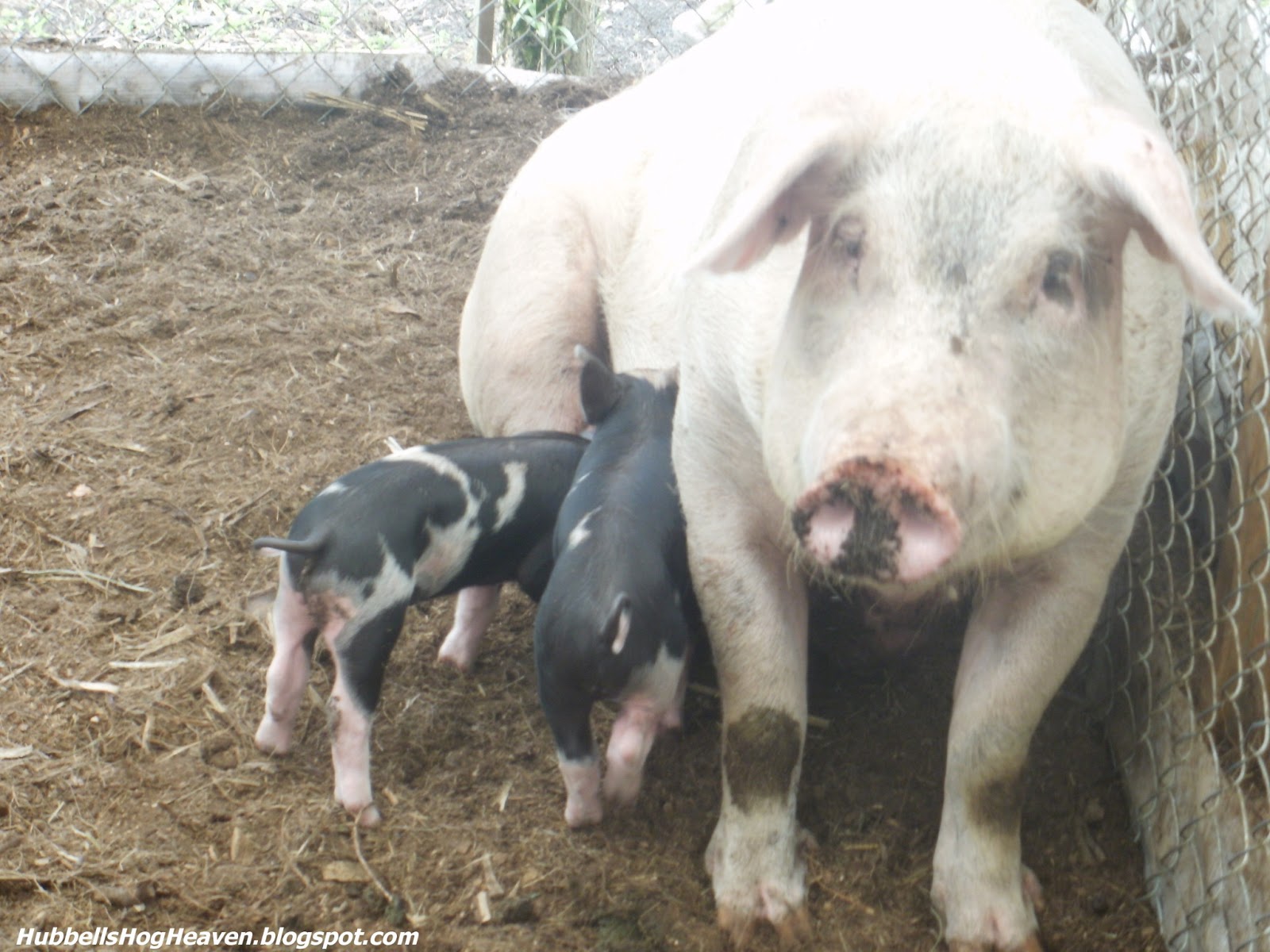
| Happy pig family at last, and a chicken visitor come to pay her respects! |
At 3:00pm we finally got a chance to breathe our sighs of relief and exhaustion, still mixed with some apprehension as to whether or not this was all going to work out. At least we knew we had tried every single thing possible. (There are some veterinarian drugs that might have helped. We tried to get some, but they were not available on the island at the time.)
I am so relieved to report that this story has a happy ending. For quite a while there, we weren't sure if it would. After such a harrowing start, Miss Pinky Pie has become a careful and attentive mama-sow. She has not lost a single piglet yet - so far, all ten are still alive. Of course, they are the cutest things ever!
Thursday, November 14, 2013
Big Mama's Small Litter
Big Mama had an easy delivery on Halloween night, the last night of October. But there were only four piglets in this litter, all females.

In trying to figure out why the litter was so small, a few things have come to mind. One, Big Mama got sick and was off her feed at weaning time for the previous litter. Since sows come into heat only 3-5 days after weaning, right when she was feeling poorly and not eating, her body probably went into starvation mode and didn't produce very many eggs at breeding time.
Another possibility is that we didn't catch her at the exact right time. A sow's heat lasts only 36 hours, and we have to get her bred twice (12 hours apart) during that time to ensure a good "take". The signs of heat can be subtle as a sow gets older, so it can be hard to catch her early enough for the second round to do any good.
We'll give Big Mama one more chance to provide a good-sized litter. And hopefully Spot will come through with another big batch like her last one, to help off-set the costs of her sister's small litter.
All four piglets are healthy and growing fast, as one would expect with such an abundant milk supply! They are such cute little things and very friendly.
PS: The farm book is now available in .pdf form, as well as paperback. This should make it easier for our international readers to obtain a copy. See the links at the left to order your copy today.

In trying to figure out why the litter was so small, a few things have come to mind. One, Big Mama got sick and was off her feed at weaning time for the previous litter. Since sows come into heat only 3-5 days after weaning, right when she was feeling poorly and not eating, her body probably went into starvation mode and didn't produce very many eggs at breeding time.
 |
| Big Mama in foreground, very pregnant and feeling just fine. |
Another possibility is that we didn't catch her at the exact right time. A sow's heat lasts only 36 hours, and we have to get her bred twice (12 hours apart) during that time to ensure a good "take". The signs of heat can be subtle as a sow gets older, so it can be hard to catch her early enough for the second round to do any good.
We'll give Big Mama one more chance to provide a good-sized litter. And hopefully Spot will come through with another big batch like her last one, to help off-set the costs of her sister's small litter.
All four piglets are healthy and growing fast, as one would expect with such an abundant milk supply! They are such cute little things and very friendly.
 |
| Only one day old, already curious. |
PS: The farm book is now available in .pdf form, as well as paperback. This should make it easier for our international readers to obtain a copy. See the links at the left to order your copy today.
Sunday, July 14, 2013
Spotted Piglets
Our Spot had an easy time with her third litter. Originally there were 15 in this batch, but they soon thinned out to 10... but these 10 are all doing really well. And they are SO cute with their many variations on the spotted pig theme!


All of these piglets are spoken for, though they still have a while to go before they will be weaned. They're growing fast though!


Meanwhile, Big Mama has been bred again using the same boar semen as Spot's last litter above, so we are hoping to see more colorful piglets come December. And the last two piglets from her recent litter are being grown to luau size for somebody's wedding celebration, so the piggery is pretty full at the moment!


All of these piglets are spoken for, though they still have a while to go before they will be weaned. They're growing fast though!


Meanwhile, Big Mama has been bred again using the same boar semen as Spot's last litter above, so we are hoping to see more colorful piglets come December. And the last two piglets from her recent litter are being grown to luau size for somebody's wedding celebration, so the piggery is pretty full at the moment!


Thursday, June 13, 2013
Piglets... and more piglets!


Big Mama's delivery went smoothly without a single hitch, 10 healthy piglets... and it was during the daytime, too. It doesn't get better than that. I'm late in reporting it because I've been concentrating on the farm book, which is getting closer and closer to publishing. (We also have another new project in the wings which will get its own post shortly.)
Back to the piglets:
Our daughter wrote about "Piglet Birthing Day" on her photo blog. She said I could share the link since I haven't had time to write about it. So, go take a look, and I'll get on with finishing up that book.
 |
| We let the sac fall away on its own naturally. |
 |
| Mama & newborns getting sprayed with LAB during her labor. |
 |
| The only assistance needed was to right away clean nose and mouth of each piglet. |
Oh, I should mention that we are down to 7 healthy piglets from this first litter. Two got squished, and one got lockjaw after castration. We're pondering the idea of not castrating in future; we'll see.


More piglets still on the way: Spot's due next week. Stay tuned!
Sunday, February 24, 2013
Late Winter News
We continue to be busy with the pigs and farm tours. All 13 piglets I wrote about in the last post thrived, grew quickly, and were sold off after weaning. They weighed an average of 40 lbs at that time.


We changed our minds about expanding the herd at this time due to the high cost of feed. Our food crops are coming along nicely, but pigs eat a lot and it takes a lot of feed each day to keep them in tip-top shape. So, we're back to just Big Mama and Spot as our breed sows. Both of them have recently been bred, with three weeks between them, so we should have an easier time of it come May and June when they're due to farrow again.

Freckles got adopted by another farmer just starting out with breeding pigs, but Penelope filled our freezer (and those of a few friends, too). She was such a noisy, loud pig that it's doubtful we could have kept her for breeding anyway, due to the fact that we have neighbors close by.

The biggest news is that I've written a book of our farm tour! It is at the editor's now; we are aiming for its release later this spring. Those of you who have been to our farm will like the book for remembering all the information presented on the tour... and those who have not had a chance to visit will be able to see more of what we are doing here. Of course, I will let you know when it is available. Meanwhile, we continue to plant food!


We changed our minds about expanding the herd at this time due to the high cost of feed. Our food crops are coming along nicely, but pigs eat a lot and it takes a lot of feed each day to keep them in tip-top shape. So, we're back to just Big Mama and Spot as our breed sows. Both of them have recently been bred, with three weeks between them, so we should have an easier time of it come May and June when they're due to farrow again.

Freckles got adopted by another farmer just starting out with breeding pigs, but Penelope filled our freezer (and those of a few friends, too). She was such a noisy, loud pig that it's doubtful we could have kept her for breeding anyway, due to the fact that we have neighbors close by.

The biggest news is that I've written a book of our farm tour! It is at the editor's now; we are aiming for its release later this spring. Those of you who have been to our farm will like the book for remembering all the information presented on the tour... and those who have not had a chance to visit will be able to see more of what we are doing here. Of course, I will let you know when it is available. Meanwhile, we continue to plant food!

Friday, December 14, 2012
Things We Learned From the Latest Farrowing
First off, a little catch up.
Our piggery currently consists of 5 finished pens housing 18 pigs of various ages. It sounds like a lot, and it certainly is, although 13 of them are new piglets.

Hammy, who weighs in at 180 pounds, will be filling our freezer soon.

His sister, Freckles, is 170 pounds and almost old enough to breed, but we may just sell her instead.

Penelope is our other gilt. She has come into heat once, so she'll likely be bred soon... or we may sell her too. She weighs 245 pounds and is cousin to the other two. She's a little older, and therefor a little bigger than they are. (Sorry, no pic of Penelope at present.)
Big Mama and Spot were both bred last August and just recently they each had their second litters. Recently... as in November 26th and 28th, respectively.
Okay, now for the lessons we learned from this last farrowing.
1. Don't do the AI too early (or too late). We think this is what happened with Spot, as she had only 5 piglets. Seeing that this was her second litter, we expected many more than that. On the other hand, they're sure growing fast without much competition for milk.

2. Don't breed the sows at the same time. It makes for a heck of a lot of work at farrowing time and hardly any sleep for us. Mike says the reason he did it this way was to pay less for the shipping of the semen, and for the potential cross-fostering of the piglets. Unfortunately, because they ended up having their litters 2 days apart, the cross-fostering thing didn't work out. (We tried.) It works best to do this within the first 24 hours or so.
3. NO fresh wood chips. We thought we were doing a favor to prep the pens for birthing by giving them a nice clean layer of fresh chips. WRONG! Warm, wet wood chips that haven't yet been inoculated with IMO's harbor the bacteria that causes mastitis. We learned this the hard way. Both our girls, one after the other, got sick with high fever, inflamed udders, loss of appetite. They just lay in misery, ignoring their piglets because they were so out of it with fever. Mike had to go out to the barn every hour, night and day, to prod them until they rolled over to nurse their piglets. Sadly, Spot lost one of her piglets during this time. Mastitis is serious stuff. We had to give the sows penicillin injections, spray them and their pens with lacto, spread IMO4 all over the bedding like crazy... and in a few days they were back on their feet, eating, and nursing well again - thank goodness!
4. Don't wait too long to assist birthing. I think we could have possibly saved a couple of Big Mama's piglets if we had gone in to assist sooner than we did. She would have had 12, but 2 were born dead. Next time, we won't wait as long.
5. Restrict feed on the due date. Pigs are reliably prompt with their due date. We did give Big Mama less feed that morning, but apparently, it was still too much. Poor Mama was throwing up with every contraction. Since Spot was a couple days later, she benefited from her sister's experience and got less feed on her due date. That seemed to help.
All in all, we are a little disappointed in having only 15 piglets born. Since it was the second litters for these sows, we thought there would be more. But we can see where circumstances may have contributed to the lower birth and survival rates, and will correct them for next time. I should mention, we lost one more piglet to internal injuries due to being stepped on, poor little thing. Thus, there are 13 piglets left to sell at weaning time.
Still, all thirteen piglets are thriving under the excellent attentiveness of their mothers.

Our piggery currently consists of 5 finished pens housing 18 pigs of various ages. It sounds like a lot, and it certainly is, although 13 of them are new piglets.

Hammy, who weighs in at 180 pounds, will be filling our freezer soon.

His sister, Freckles, is 170 pounds and almost old enough to breed, but we may just sell her instead.

Penelope is our other gilt. She has come into heat once, so she'll likely be bred soon... or we may sell her too. She weighs 245 pounds and is cousin to the other two. She's a little older, and therefor a little bigger than they are. (Sorry, no pic of Penelope at present.)
Big Mama and Spot were both bred last August and just recently they each had their second litters. Recently... as in November 26th and 28th, respectively.
Okay, now for the lessons we learned from this last farrowing.
1. Don't do the AI too early (or too late). We think this is what happened with Spot, as she had only 5 piglets. Seeing that this was her second litter, we expected many more than that. On the other hand, they're sure growing fast without much competition for milk.

2. Don't breed the sows at the same time. It makes for a heck of a lot of work at farrowing time and hardly any sleep for us. Mike says the reason he did it this way was to pay less for the shipping of the semen, and for the potential cross-fostering of the piglets. Unfortunately, because they ended up having their litters 2 days apart, the cross-fostering thing didn't work out. (We tried.) It works best to do this within the first 24 hours or so.
3. NO fresh wood chips. We thought we were doing a favor to prep the pens for birthing by giving them a nice clean layer of fresh chips. WRONG! Warm, wet wood chips that haven't yet been inoculated with IMO's harbor the bacteria that causes mastitis. We learned this the hard way. Both our girls, one after the other, got sick with high fever, inflamed udders, loss of appetite. They just lay in misery, ignoring their piglets because they were so out of it with fever. Mike had to go out to the barn every hour, night and day, to prod them until they rolled over to nurse their piglets. Sadly, Spot lost one of her piglets during this time. Mastitis is serious stuff. We had to give the sows penicillin injections, spray them and their pens with lacto, spread IMO4 all over the bedding like crazy... and in a few days they were back on their feet, eating, and nursing well again - thank goodness!
4. Don't wait too long to assist birthing. I think we could have possibly saved a couple of Big Mama's piglets if we had gone in to assist sooner than we did. She would have had 12, but 2 were born dead. Next time, we won't wait as long.
5. Restrict feed on the due date. Pigs are reliably prompt with their due date. We did give Big Mama less feed that morning, but apparently, it was still too much. Poor Mama was throwing up with every contraction. Since Spot was a couple days later, she benefited from her sister's experience and got less feed on her due date. That seemed to help.
All in all, we are a little disappointed in having only 15 piglets born. Since it was the second litters for these sows, we thought there would be more. But we can see where circumstances may have contributed to the lower birth and survival rates, and will correct them for next time. I should mention, we lost one more piglet to internal injuries due to being stepped on, poor little thing. Thus, there are 13 piglets left to sell at weaning time.
Still, all thirteen piglets are thriving under the excellent attentiveness of their mothers.

Wednesday, June 27, 2012
Second Litter of the Season

These were from a Hampshire-Yorkshire cross boar, so two of the piglets are mostly black, with white forefeet.

Mama Spot and all eight piglets are doing really well. Looks like we finally have the good mothering instincts we were looking for. We will keep two of the gilts from the first litter to increase our breeding stock. The rest of the piglets will be sold off at weaning time, at about 6 weeks of age. This means that the first litter is ready to go now, and many of them have already been picked up and headed off to their new homes. These little new ones will be ready in another 5 weeks. It's amazing how fast they grow!

Friday, May 18, 2012
Announcing the Second Generation Natural Farmed Pigs!
The piglets are here! Eight healthy piglets were farrowed May 16, 2012 by our sow Big Girl. (Those who have read past posts may recall that Big Girl was born here last year, on the 4th of July, in the first ever litter of NF pigs!)

Farrowing began at 1:35pm and continued all afternoon until about 7:00pm. After the first five, there was a pause of an hour or so before the other three came out. The placentas were all delivered easily and buried with a sprinkling of IMO4. No smell, no flies!

This litter has 7 females and only 1 male, so we won't have to do any castration this time. Normally, we would do this at 7-10 days old.


Big Girl, now Big Mama, is an excellent mother with her natural instincts intact and an ample milk supply. We couldn't be more pleased about that! All the piglets are thriving, even without heat lamps or creep area. There is enough room for mother and babies in the pen, and Mama is responsive to the babies so no worry about her squishing them.


Farrowing began at 1:35pm and continued all afternoon until about 7:00pm. After the first five, there was a pause of an hour or so before the other three came out. The placentas were all delivered easily and buried with a sprinkling of IMO4. No smell, no flies!

This litter has 7 females and only 1 male, so we won't have to do any castration this time. Normally, we would do this at 7-10 days old.


Big Girl, now Big Mama, is an excellent mother with her natural instincts intact and an ample milk supply. We couldn't be more pleased about that! All the piglets are thriving, even without heat lamps or creep area. There is enough room for mother and babies in the pen, and Mama is responsive to the babies so no worry about her squishing them.

Big Mama's appetite came back the next morning, and she is now getting extra feed to accommodate her extra nutritional and caloric needs during lactation. We divide her feed so she gets her usual amount in the mornings and an extra feeding in late afternoon. She has been sprayed with LAB a couple times to help prevent disease. We don't give inoculations, but rather, let the IMO's keep the animals healthy. The entire pen was sprinkled with IMO4 and sprayed with LAB, both before and after the birth. So far, so good. All the piggies are healthy and thriving!
Thursday, May 10, 2012
Time to Catch Up, Part 2: The Pigs
Our original two sows, Lola & Suey, made delicious additions to our freezer and our diet. Not being one to waste food, or a life, I have learned to make use of as much of the animals as possible. I make bacon with the belly meat, render beautiful healthy lard, and we've ground some of the meat into breakfast sausage. Pig trotters make a lovely addition to stew and broth... but I have yet to tackle head cheese. There are a few other choice bits still in the freezer, for future use. The bones, after being boiled for nutritive bone broth, are picked clean by the chickens, then charred to make Water-soluble Calcium Phosphate, one of our Natural Farming inputs.


Subscribe to:
Posts (Atom)